消されゆくチベットの声とアジアの人権危機
——ダライ・ラマ法王の甥が日本に鳴らした警鐘
2026年5月31日
発行元:中東アジア情報戦略研究所
An English translation is provided at the end of the Japanese text.
はじめに
2026年5月27日、参議院会館 国際会議室において「アジアの自由と人権の危機」をテーマとする講演会が開催された。講師を務めたのは、ダライ・ラマ法王の実の甥であり、チベット亡命政府元国会議員でもあるケドルプ・トゥンドック氏(Khedroob Thondup)である。
ケドルプ氏は、現ダライ・ラマ法王の血縁者として亡命チベット社会の中枢で育ち、チベット亡命政府議会議員を務めた経験を持つ。国際人権フォーラムや各国議会での証言を重ねてきた数少ない「チベット問題の生き証人」であり、法王の血縁者として、かつ政治実務者として、亡命政府内外双方の視点を持つ稀有な存在である。

※【続柄について】本記事では講師を「ダライ・ラマ法王の甥」と表記しているが、より正確にはケドルプ・トゥンドック氏は現第14世ダライ・ラマ法王の兄であるギャロ・トンドゥプ氏の息子、すなわち「甥孫(grand-nephew)」にあたるとされる。日本語の「甥」との用語の齟齬は英語圏での通称表記に由来する可能性があり、産経新聞等の原報道と照合の上ご確認いただきたい。
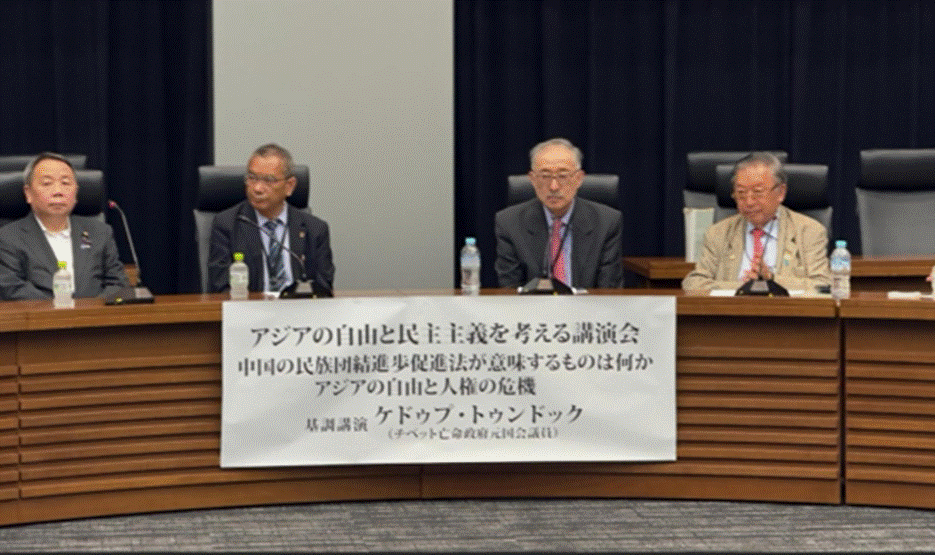
会場には現職・元国会議員、人権・民族問題の専門家、中国問題に関心を持つ一般参加者ら約70名が集まった。講演は単なる宗教・民族問題の説明にとどまらず、中国共産党による民族統治の実態と、アジア全体における自由・人権問題への警鐘として位置づけられるものであった。本講演会は産経新聞(2026年5月28日付)においても「中国で7月施行『民族団結法』にダライ・ラマ法王の甥が危機感『民族抑圧の口実に』国会内で」と題して大きく特集され、日本の主要メディアにおける注目度の高さを示した。
なお、本講演会はより広範な戦略的文脈の中に位置づけられる。2026年5月、Asia Strategic Forum・Tibet Action Institute・Closed Door Policy Consultingは、一橋大学グローバルガバナンス研究所および東京大学と連携し、インド・日本・チベットを軸とした初の構造的三者対話(Track 2)を東京で開催した。同レポート「Rethinking Tibet in the Indo-Pacific」によれば、チベット問題はもはや人道問題にとどまらず、水資源・戦略鉱物・インド太平洋安全保障に直結するインド太平洋的課題として再定位されつつある。ケドルプ氏の来日講演は、こうした組織的な国際世論形成戦略の一環として理解する必要がある。
1.講演会開催の背景
現在、日本政府は中国との経済・外交関係を重視し、対中政策では現実外交を基本路線としている。中国市場やサプライチェーンへの依存を背景に、政治・人権問題については慎重姿勢が続いている。
中国政府の公式立場は、チベット・ウイグル・内モンゴルなどに対する政策を「民族団結」と「国家統一」のための合法的・正当な施策と位置づけており、外部からの批判を内政干渉として排除する立場を一貫して維持している。
これに対し、国際人権機関や独立研究者は、以下の問題を継続的に報告・指摘している。
- 民族言語教育の制限
- 宗教活動への規制
- 愛国教育の徹底
- 監視社会化の進展
- 民族文化の均一化
今回のケドルプ氏の講演は、こうした中国の民族政策を国際社会へ訴える文脈の中に位置づけられる。
2.ケドルプ氏が日本で講演する意味
今回の来日講演には、複数の政治的・戦略的意図が存在すると考えられる。
第一に、日本社会への問題提起である。日本では中国問題が経済や安全保障の観点から語られることが多い。しかしケドルプ氏は、チベット問題は「民族自決」「宗教の自由」「文化的存続」を巡る普遍的人権問題であると強調した。
第二に、日本政府への静かなメッセージである。日本政府は中国との経済関係を重視する一方、人権問題への公式な発言には慎重である。講演では「経済関係と人権問題は切り離して論じることができない」という認識がにじんでいた。
第三に、国際世論戦としての日本活用である。チベット亡命政府は、軍事的対抗ではなく国際世論の形成を戦略の中心に据えている。民主主義国家であり国際発信力を持つ日本での講演は、「対中人権外交ネットワーク」形成の一環として位置づけられている。
3.演説の核心
ケドルプ氏が最も訴えたかったのは、「チベット問題は過去の問題ではなく、現在進行形の国際問題である」という点である。
特に重要なのが、次期ダライ・ラマ問題である。中国政府は次期ダライ・ラマ選定への介入を進めているが、ケドルプ氏は以下の立場を明確に示している。
- ダライ・ラマ制度の正統性の判断権限は中国政府にはない
- 宗教的権威はチベット民族共同体に属する
- 中国政府が認定するダライ・ラマは政治的任命に過ぎない
これは単なる宗教論争ではなく、「誰がチベット民族の精神的代表権を持つのか」という主導権をめぐる問題であり、国家主権・宗教主権・民族の文化的存続権に関わる論点である。この問題については、2025年7月2日にダライ・ラマ法王自身がガデンポタン・トラストのみが後継者認定の唯一の権限を持つと正式に声明し、同年6月に東京で開催された第9回世界チベット議員大会(Tokyo Declaration)においても、転生認定は純粋な宗教的事柄であり中国の政治的干渉に服すべきでないと確認されている。インドと日本はこの立場で収斂しつつあり、Asia Strategic Forumの同レポートはこの収斂を今後の三者対話の基盤として位置づけている。
また、中国の民族政策についても、単なる治安対策ではなく、少数民族固有の文化・言語・宗教的アイデンティティを解体し、漢民族中心の国家へと再編する政策であるとの見方が示された。ウイグル、チベット、内モンゴルに共通するのは、民族固有文化を残したまま統合するのではなく、その固有性そのものを消去する方向性であるという危機感である。2023年2月、国連人権高等弁務官事務所(OHCHR)の独立した調査により、約100万人のチベット人児童が全寮制学校に分離収容されていることが確認された。同年12月、欧州議会はこれを477対14の賛成多数で非難する決議を採択している。
非暴力と「国際世論戦」
今回の演説で特徴的だったのは、「武装独立論」ではなく、「国際世論戦」を重視していた点である。その背景には以下の戦略的思想が存在する。
- 中国との軍事対決は現実的ではない
- しかし中国は国際的な正統性の問題には脆弱である
- そのため、人権・宗教の自由・民族自決という価値観の問題として国際社会へ訴える
今回の講演は、単なる独立運動の訴えではなく、チベット亡命政府による長期的な国際世論形成戦略の一部として理解する必要がある。
4.日本へのメッセージ
講演を通じ、ケドルプ氏は日本社会に対して次の点を訴えていた。
① 中国問題を経済だけで見てはならない
中国は経済大国である一方、国内では強力な民族統制を行っているとされる。その実態を多角的に理解する必要がある。
② 人権問題はアジア全体の問題である
チベットだけでなく、ウイグル、内モンゴル、香港にも共通する問題であり、自由と人権は地域全体の課題である。
③ 日本にも役割がある
人権・宗教の自由・民族文化保護について、日本が国際社会でより積極的な役割を果たすことへの期待が示された。
5.総括
ケドルプ氏の演説は、感情的な訴えにとどまらず、以下の要素を統合した戦略性の高い政治・宗教メッセージであった。
- 中国共産党統治への批判
- 民族文化消滅への危機提起
- ダライ・ラマ後継者問題への国際的警告
- 非暴力抵抗の正当化
- 国際社会への連帯要求
チベット問題は今後、次期ダライ・ラマ認定問題を中心に、再び国際政治上の重要課題として浮上する可能性が高い。また、Asia Strategic Forumの同レポートが指摘するように、チベット高原からの河川はアジア8大河川の水源であり、15億人以上の生活を支えている。中国によるブラマプトラ川(ヤルン・ツァンポ川)への大規模ダム建設計画はインド・バングラデシュの水安全保障に直結し、チベット高原における人民解放軍の軍事インフラ拡張はインド太平洋の安全保障秩序に関わる問題でもある。この講演会は単なる民族問題のイベントではなく、「アジアの自由と人権」を巡る地政学的警告として捉える必要がある。
【スピーチ内容】
以下のスピーチは、76年間の占領を家族の記憶として持つ人物の言葉である。ケドルプ氏にとって、チベット問題は歴史書の記述ではなく、叔父であるダライ・ラマ法王の生涯と直結した、極めて個人的かつ政治的な現実である。
Tibet’s Past, Present, and Future
Ladies and gentlemen, friends of justice and truth, I stand before you today to speak of Tibet—its past independence, its present struggle, and its inevitable future of freedom.
This speech rests on four pillars: first, Tibet’s undeniable independence before 1950; second, the sacred authority of the Dalai Lama’s institution to determine his reincarnation; third, the enduring spirit of the Tibetan people despite decades of occupation; and fourth, the certainty that Tibet will one day be free again.
Before 1950, Tibet was not a province of China—it was a nation with its own government, language, culture, and international relations.
- Tibet signed treaties, maintained foreign missions, and conducted itself as a sovereign state.
- The Tibetan government managed its own affairs, from taxation to defense, without interference from Beijing.
- Travelers, scholars, and diplomats who visited Tibet before 1950 described a country distinct in its governance and identity.
The military advance of 1950 was not a “liberation”—it was, as Tibetans assert, an occupation of a free people. History cannot be rewritten by propaganda. Tibet was independent, and the world must remember this truth.
※ チベットの法的地位については、1950年以前の外交的実績(条約締結・外交使節の維持等)に基づきチベット側が独立国家であったと主張する一方、中国側は歴史的主権の継続を主張しており、国際法上の解釈は現在も学術的論争の対象となっている。
For centuries, the Tibetan Buddhist tradition has recognized reincarnations of great masters through spiritual signs, visions, and rituals. This process is sacred. It belongs to the Tibetan people and the institution of the Dalai Lama.
Yet today, the Chinese government—an atheist state—claims it has the authority to decide the next Dalai Lama. This is not only absurd, it is an insult to religious freedom and human dignity.
Let me be clear: the next Dalai Lama will be chosen by the Dalai Lama’s office, by Tibetan tradition, and by the faith of the Tibetan people. Beijing has no role, no legitimacy, and no authority in this matter.
Seventy-six years have passed since the occupation began. Generations of Tibetans have grown up under surveillance, censorship, and repression. Yet the Tibetan spirit endures.
- In monasteries, prayers continue to be whispered.
- In homes, the Tibetan language is spoken and taught to children.
- In exile, communities across India, Nepal, Europe, and America keep alive the culture of Tibet.
Tibetans, whether inside Tibet or in exile, have long embraced non-violence and passive resistance as the core of their struggle. Inspired by Buddhist teachings and the example of the Dalai Lama, they reject armed confrontation and instead rely on moral clarity, cultural resilience, and peaceful protest. In Tibet, this takes the form of quiet acts of defiance—preserving language, faith, and traditions despite state pressure. Outside Tibet, the diaspora channels its resistance into advocacy, dialogue, and international solidarity, showing that dignity and compassion can be powerful tools against oppression.
China’s “ethnic unity” law is framed as a measure to promote cohesion, but critics argue that in practice it functions as a mechanism of forced assimilation. By compelling minority groups to abandon their languages, traditions, and spiritual practices, it risks stripping away the foundations of identity. What is presented as unity may in effect accelerate the dismantling of cultural diversity—a policy that raises serious concerns among international human rights observers. Instead of protecting cultural coexistence, it enforces homogenization under Party-defined “Chineseness,” affecting the distinctiveness of Tibetans, Uyghurs, Mongols, and others.
※ 「民族団結」政策の評価については、中国政府と国際人権機関の間で見解が大きく異なる。本段落はケドルプ氏および国際人権団体の見解を反映したものである。
China has tried to erase Tibetan identity through propaganda, forced education, and control of religion. But no amount of pressure can erase the soul of a people. The Tibetan spirit is rooted in compassion, dignity, and resilience. It cannot be destroyed.
History teaches us that no occupation lasts forever. The arc of justice bends toward freedom.
※ ソ連崩壊や植民地独立運動との歴史的類推については、地政学的条件の差異も存在する。この見解はケドルプ氏の歴史的確信として示されたものである。
Tibet’s struggle is part of a global movement for self-determination and human rights. Around the world, voices are rising to demand accountability, to expose repression, and to stand with Tibet.
Independence is not a dream—it is a destiny. The mountains of Tibet stand eternal, and so does the spirit of its people. One day, Tibet will be free again.
Let us remember the four truths:
- Tibet was independent before 1950.
- The Dalai Lama’s reincarnation belongs to Tibetans, not China.
- The Tibetan spirit endures despite occupation.
- Tibet will be independent in the future.
Friends, freedom is not given—it is claimed, lived, and defended. Tibet’s story is not finished. The world must stand with Tibet, for justice, for dignity, and for freedom.
Tibet will be free.
【参考資料】
以下の資料は、本記事の事実確認および文脈理解に際して参照すべき主要文献・機関報告である。
チベットの歴史的地位
- Goldstein, Melvyn C. A History of Modern Tibet, 1913–1951. University of California Press, 1989.
- van Walt van Praag, Michael C. The Status of Tibet: History, Rights, and Prospects in International Law. Westview Press, 1987.
- シムラ条約(1914年)関連文書——チベット・英国・中国三者間交渉記録
ダライ・ラマ転生・後継者問題
- U.S. Tibetan Policy and Support Act of 2020(米国チベット政策支援法)
- European Parliament Resolution on Tibet, 2021
- Central Tibetan Administration(チベット亡命政府)公式声明:www.tibet.net
中国の民族政策
- Human Rights Watch. “Eradicating Ideological Viruses”: China’s Campaign of Repression Against Xinjiang’s Muslims. 2018.
- Amnesty International. Tibet 2023 Annual Report.
- UN Committee on the Elimination of Racial Discrimination (CERD). Concluding Observations on China, 2018.
- Congressional-Executive Commission on China (CECC). Annual Report 2023.
チベット亡命政府・中道の道(Umaylam)
- Central Tibetan Administration. “The Middle Way Approach: A Framework for Resolving the Issue of Tibet.” Dharamsala, 2008.
- International Campaign for Tibet(チベット支援国際キャンペーン):www.savetibet.org
国際人権法・宗教の自由
- UN Declaration on the Rights of Persons Belonging to National or Ethnic, Religious and Linguistic Minorities, 1992.
- International Covenant on Civil and Political Rights (ICCPR), Article 18(宗教の自由)、Article 27(少数民族の権利)
- US Commission on International Religious Freedom (USCIRF). Annual Report 2024.
日本の対中人権外交
- 外務省「人権外交」関連資料:www.mofa.go.jp
- 日本チベット国会議員連盟 活動記録
- 人権外交を超党派で考える議員連盟 関連文書
関連報道
インド・日本・チベット三者対話
- Asia Strategic Forum, Tibet Action Institute, Closed Door Policy Consulting. “Rethinking Tibet in the Indo-Pacific: A Report on the First Structured Trilateral Dialogue on India-Japan-Tibet.” Tokyo Programme, May 2026.
- Tibet Action Institute. “‘When They Came to Take Our Children:’ China’s Colonial Boarding Schools and the Future of Tibet.” May 2025.
- Tokyo Declaration, 9th World Parliamentarians’ Convention on Tibet, Tokyo, June 2025.
- China Aerospace Studies Institute (CASI). “Remote Basing: People’s Liberation Army Logistics on the Tibetan Plateau.” September 2025.
- Center for Strategic and International Studies (CSIS). “China’s Gray-Zone Infrastructure Strategy on the Tibetan Plateau.” June 2025.
筆者: 舩山 美保 中東アジア情報戦略研究所 フェロー
国際標準化、技術インテリジェンス、知的財産分析、地政学・危機管理を専門とする戦略アナリスト。 キヤノン株式会社において国際標準・新技術分野の特許調査および戦略分析業務に従事。ISO/IEC JTC 1/SC 28(オフィス機器)副国際幹事として、国際規格策定および多国間交渉の調整を担い、国際標準化活動への貢献によりITSCJ国際標準化貢献賞を3回受賞。 現在、一般財団法人 日本危機管理研究所 理事。公益社団法人 日本外国特派員協会(FCCJ)プロフェッショナル・アソシエイト会員。 上智大学国際政治学科卒業。青山学院大学大学院修了(国際政治経済学・哲学・心理学)。
The Silenced Voice of Tibet and Asia’s Human Rights Crisis
— A Warning Sounded in Japan by the Nephew of His Holiness the Dalai Lama
May 31, 2026
Institute of Middle East Asia Information Strategy
Author: Miho Funayama
Introduction
On 27 May 2026, a symposium entitled “The Crisis of Freedom and Human Rights in Asia” was held at the International Conference Room of the House of Councillors Members’ Office Building in Tokyo. The keynote speaker was Khedroob Thondup, the biological nephew of His Holiness the Dalai Lama and a former member of the Tibetan Parliament-in-Exile.
Khedroob Thondup was raised at the heart of the Tibetan exile community as a blood relative of His Holiness the Dalai Lama. He has served as a member of the Tibetan Parliament-in-Exile and has testified before international human rights forums and national parliaments around the world. He is one of the rare living witnesses to the Tibet issue — a unique individual who holds both the perspective of the Dalai Lama’s inner circle and that of a former political practitioner.

Note on family relationship: This article refers to the speaker as the “nephew” of His Holiness the Dalai Lama, following common usage in English-language reporting. More precisely, Khedroob Thondup is the son of Gyalo Thondup, the elder brother of the 14th Dalai Lama, making him a grand-nephew. Readers and citing authors are advised to verify against original sources including the Sankei Shimbun report.
Approximately 70 participants attended the event, including serving and former members of the Japanese Diet, specialists in human rights and ethnic affairs, and members of the public with an interest in China-related issues. The symposium went beyond a mere explanation of religious or ethnic concerns; it served as a warning about the realities of ethnic governance under the Chinese Communist Party and the broader crisis of freedom and human rights across Asia. The event was also featured prominently in the Sankei Shimbun (28 May 2026) under the headline: “Nephew of the Dalai Lama Expresses Alarm over China’s ‘Ethnic Unity Law’ Set to Take Effect in July: ‘A Pretext for Ethnic Oppression’ — Inside the National Diet,” underscoring the high level of attention it received in Japan’s mainstream media.
It should also be noted that this symposium forms part of a broader strategic context. In May 2026, the Asia Strategic Forum, Tibet Action Institute, and Closed Door Policy Consulting, in partnership with the Institute for Global Governance Research at Hitotsubashi University and the University of Tokyo, convened the first structured trilateral Track 2 dialogue on India, Japan, and Tibet in Tokyo. According to the report “Rethinking Tibet in the Indo-Pacific,” Tibet is increasingly being repositioned not merely as a humanitarian concern but as an Indo-Pacific issue with direct implications for water security, strategic minerals, and regional security architecture. Khedroob Thondup’s visit and lecture should be understood as part of this coordinated international public diplomacy strategy.
1. Background to the Symposium
The Japanese government currently prioritises its economic and diplomatic relationship with China, pursuing a pragmatic foreign policy as its baseline approach. Against a backdrop of deep dependence on Chinese markets and supply chains, Japan has maintained a consistently cautious posture on political and human rights issues.
The Chinese government’s official position frames its policies toward Tibet, Xinjiang, and Inner Mongolia as lawful and legitimate measures in pursuit of “ethnic unity” and national integration, consistently rejecting external criticism as interference in internal affairs.
Against this, international human rights bodies and independent researchers have repeatedly documented the following concerns:
At the same time, international human rights bodies and researchers have repeatedly pointed to the implementation of coercive ethnic governance policies across China. In particular, the following concerns have been documented in the regions of historic Tibet, Xinjiang (Uyghur), and Inner Mongolia:
- Restrictions on minority-language education
- Regulation of religious practice
- Enforcement of patriotic education campaigns
- Expansion of surveillance infrastructure
- Homogenisation of ethnic and cultural identity
Khedroob Thondup’s lecture is situated within this context of advocating to the international community against China’s ethnic minority policies.
2. The Significance of Khedroob Thondup’s Lecture in Japan
The visit to Japan carries multiple political and strategic dimensions.
First, it represents a direct challenge to Japanese public discourse. In Japan, China-related issues tend to be framed predominantly through the lenses of economics and security. Khedroob Thondup, however, emphasised that the Tibet issue is fundamentally a universal human rights question — one concerning the rights to self-determination, freedom of religion, and cultural survival.
Second, it constitutes a quiet message to the Japanese government. While Japan prioritises its economic relationship with China, it has been notably reluctant to make official statements on human rights. The lecture conveyed a clear sense of urgency: that economic relations and human rights cannot be treated as separate concerns.
Third, it reflects the strategic use of Japan as a platform for international public diplomacy. The Tibetan Government-in-Exile has positioned the shaping of international public opinion — rather than military confrontation — at the centre of its strategy. Holding a lecture in Japan, a democracy with significant international reach, is understood as part of building a network for human rights diplomacy vis-à-vis China.
3. The Core of the Address
The central message Khedroob Thondup sought to convey was that “the Tibet issue is not a matter of the past — it is an ongoing international concern of the present.”
Of particular significance is the question of the next Dalai Lama. While the Chinese government is advancing its effort to intervene in the selection of the next Dalai Lama, Khedroob Thondup articulated the following positions clearly:
- The authority to determine the legitimacy of the Dalai Lama institution does not reside with the Chinese government.
- Spiritual authority belongs to the Tibetan people and their community.
- Any Dalai Lama recognised by the Chinese government would be nothing more than a political appointee.
This is not merely a religious dispute. At its core, it is a contest over who holds the right to represent the Tibetan people spiritually — a question touching on state sovereignty, religious sovereignty, and the right to cultural survival. On this issue, His Holiness the Dalai Lama himself issued a formal statement on 2 July 2025 affirming that the Gaden Phodrang Trust holds sole authority over the recognition of his successor. The Tokyo Declaration, produced at the 9th World Parliamentarians’ Convention on Tibet held in Tokyo in June 2025, likewise confirmed that the recognition of the reincarnation is a purely religious matter that must not be subject to political interference by the People’s Republic of China. India and Japan are converging on this position, and the Asia Strategic Forum report identifies this convergence as the foundation for future trilateral dialogue.
Regarding China’s ethnic minority policies more broadly, the view was advanced that these represent not merely security measures but a systematic effort to dismantle the distinct cultural, linguistic, and religious identities of ethnic minorities and reconstitute a Han-centric state. What Tibetans, Uyghurs, and Mongolians share is the concern that the direction of policy is not integration while preserving ethnic distinctiveness, but the erasure of that distinctiveness itself. In February 2023, the UN Office of the High Commissioner for Human Rights (OHCHR) independently confirmed that approximately one million Tibetan children have been separated from their families and placed in state-run boarding schools. In December of the same year, the European Parliament condemned this by 477 votes to 14.
Non-Violence and the “Battle for International Public Opinion”
What distinguished this address was its emphasis not on armed independence but on winning the battle for international public opinion. Underlying this approach is the following strategic logic:
- Military confrontation with China is not a realistic option.
- However, China is vulnerable on questions of international legitimacy.
- The most effective approach is therefore to frame the issue as one of values — human rights, freedom of religion, and the right to self-determination — and appeal to the international community on those grounds.
This lecture must be understood not as a simple call for independence, but as part of a long-term international public diplomacy strategy by the Tibetan Government-in-Exile.
4. The Message to Japan
Throughout the lecture, Khedroob Thondup conveyed the following points to Japanese society:
① China must not be viewed through an economic lens alone.
While China is a major economic power, it is simultaneously conducting extensive ethnic controls domestically. A more multifaceted understanding of that reality is needed.
② Human rights are an issue for the whole of Asia.
The concerns are not confined to Tibet — they are shared across Xinjiang, Inner Mongolia, and Hong Kong. Freedom and human rights are a challenge for the entire region.
③ Japan has a role to play.
An expectation was expressed that Japan should play a more active role in the international community on the issues of human rights, freedom of religion, and the protection of ethnic cultures.
5. Conclusion
Khedroob Thondup’s address was far more than an emotional appeal. It was a highly strategic political and religious message that integrated the following elements:
- A critique of Chinese Communist Party governance
- A warning about the destruction of ethnic minority cultures
- An international alarm regarding the Dalai Lama succession
- A justification of non-violent resistance
- A call for solidarity from the international community
The Tibet issue is likely to re-emerge as a major item on the international political agenda, with the question of recognising the next Dalai Lama at its centre. As the Asia Strategic Forum report also notes, the rivers originating on the Tibetan Plateau are the source of eight of Asia’s major rivers, sustaining the lives of more than 1.5 billion people. China’s announced plan to construct the world’s largest hydroelectric dam on the Yarlung Tsangpo (Brahmaputra) has direct implications for the water security of India and Bangladesh, and the PLA’s expansion of military infrastructure on the Tibetan Plateau is a matter bearing on the security order of the entire Indo-Pacific. This symposium must be understood not merely as an ethnic affairs event, but as a geopolitical warning concerning the future of freedom and human rights in Asia.
[Speech]
The following speech is the testimony of a man who carries seventy-six years of occupation as a family memory. For Khedroob Thondup, the Tibet issue is not a passage in a history book — it is a deeply personal and political reality, inseparable from the life of his uncle, His Holiness the Dalai Lama.
Tibet’s Past, Present, and Future
Ladies and gentlemen, friends of justice and truth, I stand before you today to speak of Tibet—its past independence, its present struggle, and its inevitable future of freedom.
This speech rests on four pillars: first, Tibet’s undeniable independence before 1950; second, the sacred authority of the Dalai Lama’s institution to determine his reincarnation; third, the enduring spirit of the Tibetan people despite decades of occupation; and fourth, the certainty that Tibet will one day be free again.
Before 1950, Tibet was not a province of China—it was a nation with its own government, language, culture, and international relations.
- Tibet signed treaties, maintained foreign missions, and conducted itself as a sovereign state.
- The Tibetan government managed its own affairs, from taxation to defense, without interference from Beijing.
- Travelers, scholars, and diplomats who visited Tibet before 1950 described a country distinct in its governance and identity.
The military advance of 1950 was not a “liberation”—it was, as Tibetans assert, an occupation of a free people. History cannot be rewritten by propaganda. Tibet was independent, and the world must remember this truth.
Note: The legal status of Tibet prior to 1950 remains a subject of ongoing academic and legal debate. Tibet asserts its independence based on its record of diplomatic conduct, including treaty-making and the maintenance of foreign missions; China maintains that its historical sovereignty over Tibet was never interrupted. The international legal interpretation remains contested.
For centuries, the Tibetan Buddhist tradition has recognized reincarnations of great masters through spiritual signs, visions, and rituals. This process is sacred. It belongs to the Tibetan people and the institution of the Dalai Lama.
Yet today, the Chinese government—an atheist state—claims it has the authority to decide the next Dalai Lama. This is not only absurd, it is an insult to religious freedom and human dignity.
Let me be clear: the next Dalai Lama will be chosen by the Dalai Lama’s office, by Tibetan tradition, and by the faith of the Tibetan people. Beijing has no role, no legitimacy, and no authority in this matter.
Seventy-six years have passed since the occupation began. Generations of Tibetans have grown up under surveillance, censorship, and repression. Yet the Tibetan spirit endures.
- In monasteries, prayers continue to be whispered.
- In homes, the Tibetan language is spoken and taught to children.
- In exile, communities across India, Nepal, Europe, and America keep alive the culture of Tibet.
Tibetans, whether inside Tibet or in exile, have long embraced non-violence and passive resistance as the core of their struggle. Inspired by Buddhist teachings and the example of the Dalai Lama, they reject armed confrontation and instead rely on moral clarity, cultural resilience, and peaceful protest. In Tibet, this takes the form of quiet acts of defiance—preserving language, faith, and traditions despite state pressure. Outside Tibet, the diaspora channels its resistance into advocacy, dialogue, and international solidarity, showing that dignity and compassion can be powerful tools against oppression.
China’s “ethnic unity” law is framed as a measure to promote cohesion, but critics argue that in practice it functions as a mechanism of forced assimilation. By compelling minority groups to abandon their languages, traditions, and spiritual practices, it risks stripping away the foundations of identity. What is presented as unity may in effect accelerate the dismantling of cultural diversity — a policy that raises serious concerns among international human rights observers. Instead of protecting cultural coexistence, it enforces homogenization under Party-defined “Chineseness,” affecting the distinctiveness of Tibetans, Uyghurs, Mongols, and others.
Note: Assessments of the “Ethnic Unity” policy differ significantly between the Chinese government and international human rights organisations. This passage reflects the views of Khedroob Thondup and international human rights bodies.
China has tried to erase Tibetan identity through propaganda, forced education, and control of religion. But no amount of pressure can erase the soul of a people. The Tibetan spirit is rooted in compassion, dignity, and resilience. It cannot be destroyed.
History teaches us that no occupation lasts forever. The arc of justice bends toward freedom.
Note: The historical analogy with the collapse of the Soviet Union and decolonisation movements involves significant differences in geopolitical conditions. This view is presented as Khedroob Thondup’s personal historical conviction.
Tibet’s struggle is part of a global movement for self-determination and human rights. Around the world, voices are rising to demand accountability, to expose repression, and to stand with Tibet.
Independence is not a dream—it is a destiny. The mountains of Tibet stand eternal, and so does the spirit of its people. One day, Tibet will be free again.
Let us remember the four truths:
- Tibet was independent before 1950.
- The Dalai Lama’s reincarnation belongs to Tibetans, not China.
- The Tibetan spirit endures despite occupation.
- Tibet will be independent in the future.
Friends, freedom is not given—it is claimed, lived, and defended. Tibet’s story is not finished. The world must stand with Tibet, for justice, for dignity, and for freedom.
Tibet will be free.
References
The following sources are recommended as primary references for fact-checking and contextual understanding of the issues covered in this report.
Historical Status of Tibet
- Goldstein, Melvyn C. A History of Modern Tibet, 1913–1951. University of California Press, 1989.
- van Walt van Praag, Michael C. The Status of Tibet: History, Rights, and Prospects in International Law. Westview Press, 1987.
- Simla Convention (1914) — Documents relating to tripartite negotiations between Tibet, Britain, and China.
Dalai Lama Reincarnation and Succession
- U.S. Tibetan Policy and Support Act of 2020.
- European Parliament Resolution on Tibet, 2021.
- Central Tibetan Administration. Official Statements: www.tibet.net
China’s Ethnic Minority Policies
- Human Rights Watch. “Eradicating Ideological Viruses”: China’s Campaign of Repression Against Xinjiang’s Muslims. 2018.
- Amnesty International. Tibet 2023 Annual Report.
- UN Committee on the Elimination of Racial Discrimination (CERD). Concluding Observations on China, 2018.
- Congressional-Executive Commission on China (CECC). Annual Report 2023.
Tibetan Government-in-Exile and the Middle Way Approach (Umaylam)
- Central Tibetan Administration. “The Middle Way Approach: A Framework for Resolving the Issue of Tibet.” Dharamsala, 2008.
- International Campaign for Tibet: www.savetibet.org
International Human Rights Law and Freedom of Religion
- UN Declaration on the Rights of Persons Belonging to National or Ethnic, Religious and Linguistic Minorities, 1992.
- International Covenant on Civil and Political Rights (ICCPR), Article 18 (Freedom of Religion), Article 27 (Rights of Minorities).
- US Commission on International Religious Freedom (USCIRF). Annual Report 2024.
Japan’s Human Rights Diplomacy toward China
- Ministry of Foreign Affairs of Japan. Materials on Human Rights Diplomacy: www.mofa.go.jp
- Japan-Tibet Parliamentary Friendship League. Activity Records.
- Cross-Party Parliamentary League for Human Rights Diplomacy. Related Documents.
Related Media Coverage
- Sankei Shimbun. “Nephew of the Dalai Lama Expresses Alarm over China’s ‘Ethnic Unity Law’ Set to Take Effect in July: ‘A Pretext for Ethnic Oppression’ — Inside the National Diet.” 28 May 2026. https://www.sankei.com/article/20260528-DIWUBIZC3VC2TFPKAYH45F25ZM/
India-Japan-Tibet Trilateral Dialogue
- Asia Strategic Forum, Tibet Action Institute, Closed Door Policy Consulting. “Rethinking Tibet in the Indo-Pacific: A Report on the First Structured Trilateral Dialogue on India-Japan-Tibet.” Tokyo Programme, May 2026.
- Tibet Action Institute. “‘When They Came to Take Our Children:’ China’s Colonial Boarding Schools and the Future of Tibet.” May 2025.
- Tokyo Declaration, 9th World Parliamentarians’ Convention on Tibet, Tokyo, June 2025.
- China Aerospace Studies Institute (CASI). “Remote Basing: People’s Liberation Army Logistics on the Tibetan Plateau.” September 2025.
- Center for Strategic and International Studies (CSIS). “China’s Gray-Zone Infrastructure Strategy on the Tibetan Plateau.” June 2025.
Author: Miho Funayama
An international standards strategist and geopolitical analyst with expertise in international standardization, technology intelligence, intellectual property analysis, and multilateral negotiation. She served at Canon Inc., where she specialized in patent research and strategic analysis of international standards and emerging technologies. As Vice International Secretary of ISO/IEC JTC 1/SC 28 (Office Equipment), she played a leading role in the development and coordination of international standards through multinational consensus-building and negotiation processes. In recognition of her contributions to international standardization, she received the ITSCJ International Standardization Contribution Award on three occasions.
She currently serves as Director of the Japan Institute for Crisis Management and is also affiliated with the Institute of Middle East Asia Intelligence Strategy as a fellow . She is a Professional Associate Member of The Foreign Correspondents’ Club of Japan (FCCJ).
She holds a B.A. in International Politics from Sophia University and an M.A. from Aoyama Gakuin University Graduate School, with interdisciplinary studies in International Political Economy, Philosophy, and Psychology.