
Published by:
Middle East and Asia Strategic Information Institute
July 14, 2026
Category: Middle East Security and Geopolitical Analysis
Table of Contents
- Executive Summary
- Introduction
- Chapter 1 The Fundamental Structure of Iraqi Politics
- Chapter 2 The Reality of the Pro-Iran Sphere of Influence
- Chapter 3 The Central Government and the Balanced Diplomacy Bloc
- Chapter 4 The Kurdish Sphere of Influence
- Chapter 5 The Sunni and Gulf-Oriented Bloc
- Chapter 6 Regional Distribution of Political Forces
- Chapter 7 Iraq as a Four-Pole Political Structure
- Conclusion
- References
- Sources of Figures and Maps
Executive Summary
As of 2026, Iraq possesses one of the most complex political and security structures in the Middle East.
Following the regime change in 2003, Iraq established a political system based primarily on the country’s three principal communities—the Shi’a, Sunni, and Kurdish populations. However, the continued influence of neighboring states, together with the presence of numerous armed organizations, has resulted in the persistence of a multilayered power structure.
Contemporary Iraqi politics can be understood through four principal spheres of influence:
- The Pro-Iran Bloc
- The Central Government and Balanced Diplomacy Bloc
- The Kurdish Bloc
- The Sunni and Gulf-Oriented Bloc
In the military and security sectors, pro-Iran forces continue to maintain a dominant position. In contrast, the economic sphere has witnessed expanding investment from the Gulf states and Türkiye.
Meanwhile, the Iraqi central government pursues a strategy of balanced diplomacy by maintaining constructive relations with the United States, China, Iran, and the Gulf states, thereby functioning as a regional balancer among competing major powers.
The Middle East and Asia Strategic Information Institute (MEASII) assesses present-day Iraq as a four-pole state in which pro-Iran forces retain political and military predominance, while Türkiye, the Gulf states, and the United States compete for economic influence and broader regional leverage.
Introduction
Located at the heart of the Middle East, Iraq occupies a strategically significant position where the interests of numerous major regional and global actors—including Iran, Türkiye, the Gulf states, the United States, and China—converge.
In recent years, Iraq has experienced the simultaneous expansion of Gulf investment, China’s Belt and Road Initiative (BRI), Türkiye’s cross-border security strategy, Iran’s efforts to preserve its regional influence, and continuing debates over the presence of U.S. military forces. Together, these developments have contributed to the emergence of a new geopolitical landscape.
This report analyzes Iraq’s political, military, diplomatic, and economic structures as of 2026 and examines how these dynamics may influence the future geopolitical reconfiguration of the Middle East.
Chapter 1 The Fundamental Structure of Iraqi Politics
1.1 Iraqi Politics as a Four-Pole Structure
As of 2026, Iraq possesses a complex political structure that cannot be adequately explained solely by sectarian or ethnic divisions.
Following the collapse of the regime of Saddam Hussein in 2003, a political system based on the country’s Shi’a, Sunni, and Kurdish communities was established. Since then, however, the continuing influence of neighboring states and the presence of various domestic armed organizations have sustained a multilayered distribution of political power.
Contemporary Iraqi politics can be understood through four principal spheres of influence.
(1) The Pro-Iran Bloc
Centered in the predominantly Shi’a provinces of southern Iraq, this bloc exercises significant influence over the Iraqi Parliament, security institutions, and provincial administrations.
Its principal organizations include the Badr Organization, Asa’ib Ahl al-Haq> (AAH), and the Popular Mobilization Forces> (PMF).
(2) The Central Government and Balanced Diplomacy Bloc
This bloc is centered on the federal government in Baghdad and pursues a policy of balanced diplomacy by maintaining constructive relations with Iran, the United States, China, and the Gulf states.
(3) The Kurdish Bloc
Based in the Kurdistan Region of northern Iraq, this sphere is led primarily by two dominant political parties: the Kurdistan Democratic Party (KDP) and the Patriotic Union of Kurdistan (PUK).
(4) The Sunni and Gulf-Oriented Bloc
Centered in Mosul and Al Anbar Governorate, this bloc emphasizes economic cooperation with the Gulf states and prioritizes post-conflict reconstruction and regional development.
1.2 The Current Balance of Political Forces
Although Iraq formally remains a unified sovereign state, its political reality is characterized by distinct regional power centers, each possessing different territorial bases and foreign policy orientations.
In southern Iraq, pro-Iran forces continue to maintain political predominance. In the north, the Kurdistan Region is jointly led by the KDP and the PUK. Meanwhile, the Sunni-majority provinces have strengthened their relations with the Gulf states, driven largely by reconstruction investment and economic cooperation.
The federal government seeks to preserve national stability by maintaining a balance among these competing political forces.
1.3 Geopolitical Characteristics
Contemporary Iraq possesses several defining geopolitical characteristics.
- A strategic buffer state between Iran and the Gulf Arab states
- A key hub within China’s Belt and Road Initiative (BRI)
- An integral component of Türkiye’s southern security strategy
- A region where the United States continues to maintain significant strategic influence through its military presence
Consequently, Iraq remains one of the most strategically important states in the contemporary Middle East.
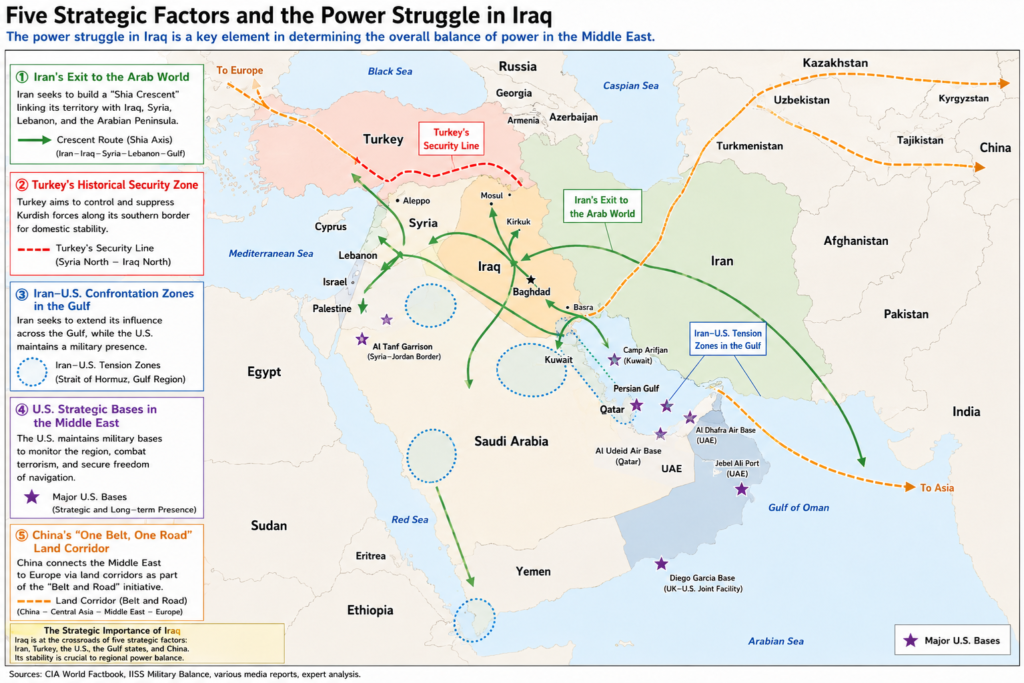
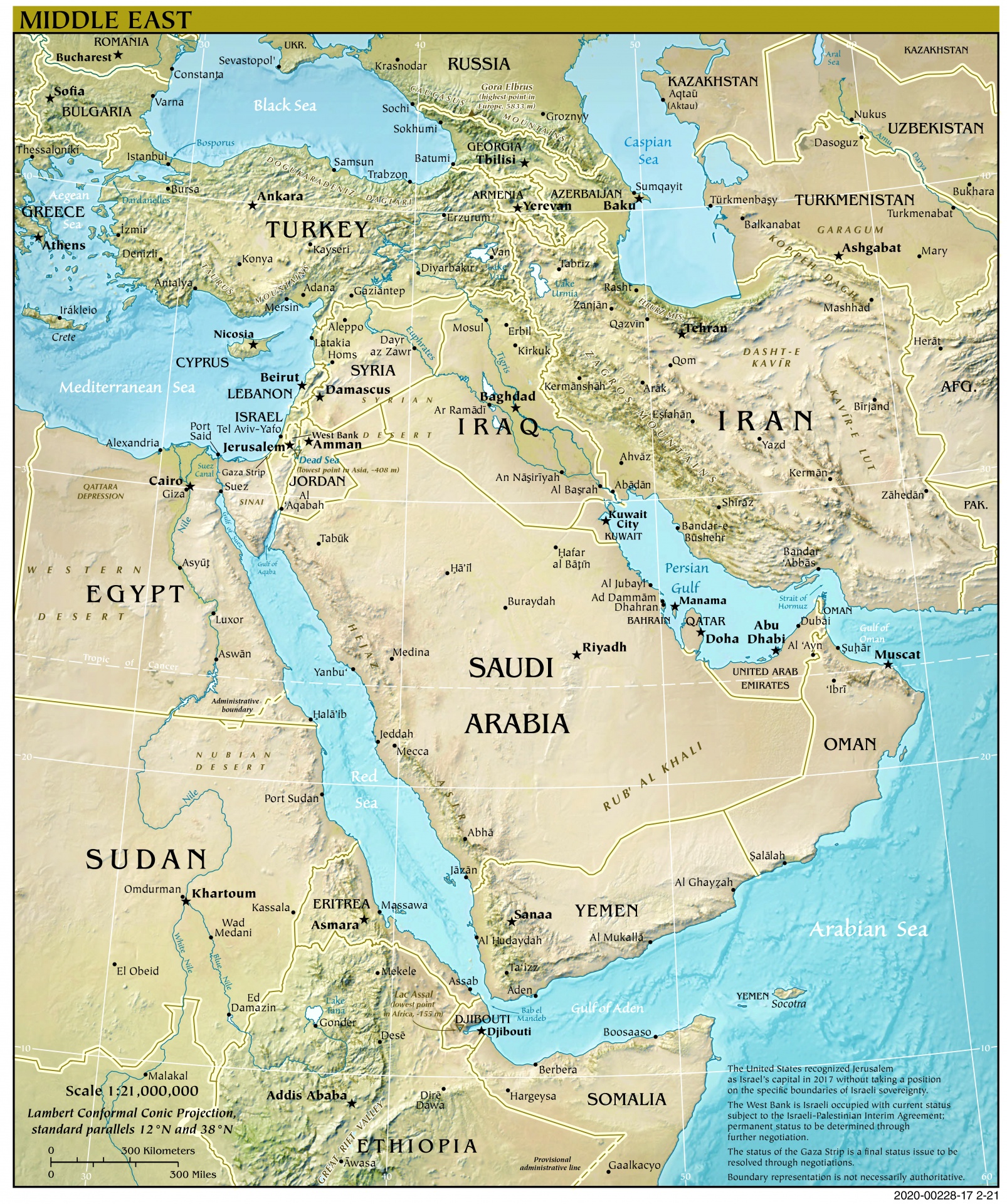
Figure 1
Source: Prepared by the Middle East and Asia Strategic Information Institute (MEASII) based on the CIA World Factbook – Middle East Political Map and the UNOCHA Iraq Administrative Map.
Note: This figure is a conceptual illustration compiled from publicly available information concerning administrative boundaries, major cities, political parties, armed organizations, and spheres of political influence. It should not be interpreted as an exact representation of territorial control or the prevailing security situation.
Additional Note: Rather than depicting official administrative divisions, this map illustrates the geopolitical spheres of influence in Iraq during 2025–2026 based on political alignments, sectarian affiliations, and foreign policy orientations. Accordingly, the boundaries shown do not necessarily correspond to official provincial borders.
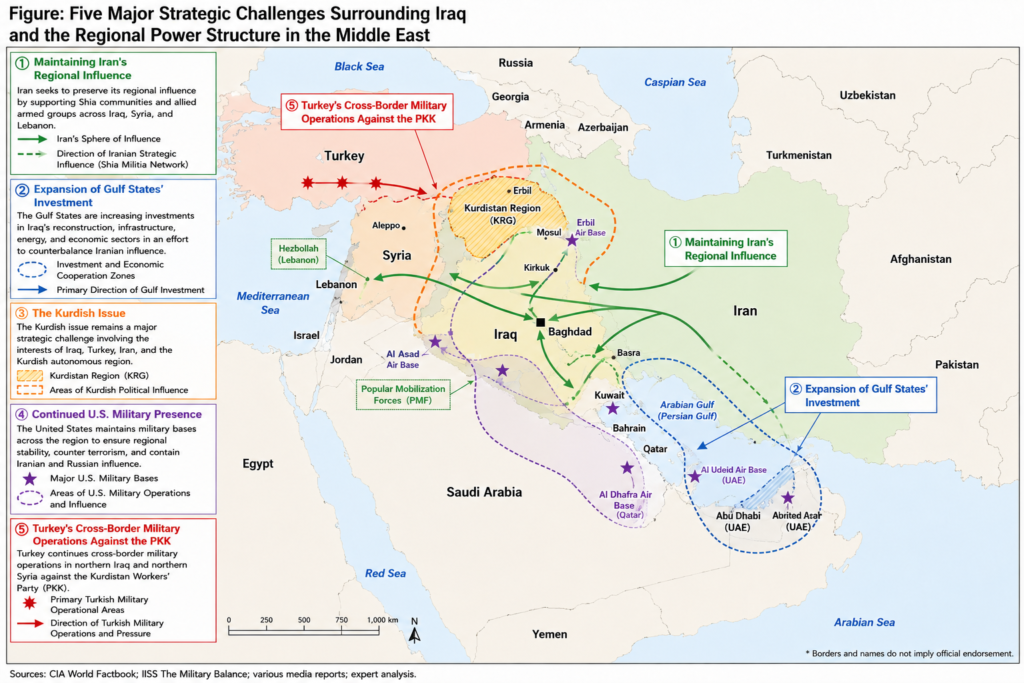
Figure 2
Source: Prepared by the Middle East and Asia Strategic Information Institute (MEASII) based on the CIA World Factbook (Iraq Maps), UNOCHA Iraq Administrative Boundaries Map, United Nations Assistance Mission for Iraq (UNAMI) Reports, International Crisis Group Reports, Institute for the Study of War (ISW) Iraq Assessments, publications of the Independent High Electoral Commission of Iraq (IHEC), and official materials released by the Kurdistan Regional Government (KRG).
Note: This figure is a conceptual illustration compiled from publicly available information concerning administrative boundaries, major cities, political parties, armed organizations, and spheres of political influence. It should not be interpreted as an exact representation of territorial control or the prevailing security situation.
Additional Note: This map represents geopolitical spheres of influence rather than formal administrative divisions. It reflects the political, sectarian, and diplomatic landscape of Iraq during 2025–2026 and therefore does not necessarily coincide with official provincial boundaries.
Chapter 2 The Reality of the Pro-Iran Sphere of Influence
2.1 Overview of the Sphere of Influence
The Pro-Iran Sphere of Influence is primarily based in the Shi’a-majority provinces of southern Iraq.
Its principal areas include:
- Basra
- Najaf
- Karbala
- Maysan Governorate
- Wasit Governorate
- Southern Diyala Governorate
Supported by extensive Shi’a religious networks and Iraq’s major oil-producing regions, these areas constitute one of the principal foundations of the country’s political system.
2.2 The Badr Organization
The Badr Organization is one of the oldest Shi’a political and military organizations in Iraq.
Originally established during the Iran–Iraq War, it subsequently evolved into a major political organization.
Today, the organization exercises substantial influence over:
- the Iraqi Parliament,
- the Ministry of Interior,
- national security institutions, and
- provincial administrations.
The Badr Organization is widely regarded as one of the core pillars of Iraq’s Pro-Iran political establishment.
2.3 Asa’ib Ahl al-Haq (AAH)
The Asa’ib Ahl al-Haq (AAH) is one of Iraq’s most prominent pro-Iran armed organizations.
Its leader is Qais al-Khazali.
The organization is characterized by:
- a well-established armed structure,
- a strongly pro-Iran political orientation,
- significant capacity to mobilize Shi’a constituencies, and
- considerable influence within the Iraqi Parliament.
AAH continues to maintain substantial political influence throughout southern Iraq and the greater Baghdad area.
2.4 The Popular Mobilization Forces (PMF)
The Popular Mobilization Forces (PMF) was established in 2014 in response to the crisis created by the rapid territorial expansion of Islamic State.
Initially formed as a coalition of volunteer militias to combat ISIS, the PMF subsequently acquired formal legal status as a state security institution.
Today, the organization possesses:
- several hundred thousand personnel,
- its own command structure, and
- an extensive nationwide organizational network.
The PMF has consequently become Iraq’s second-largest security organization after the Iraqi Armed Forces. Although the PMF consists of numerous constituent organizations with differing political affiliations, pro-Iran factions continue to exercise considerable influence within its command structure.
2.5 Geopolitical Characteristics of the Pro-Iran Sphere
The defining characteristic of the Pro-Iran Sphere of Influence is the close integration of three mutually reinforcing dimensions: religion, military power, and political authority.
From a religious perspective, the bloc maintains close ties with the leading Shi’a religious establishments in Najaf and Karbala.
Militarily, it has developed an extensive security network through the PMF and its affiliated organizations.
Politically, pro-Iran parties continue to exercise significant influence within both the Iraqi Parliament and government institutions.
Furthermore, sustained cooperation with Iran continues through:
- extensive people-to-people exchanges,
- economic relations,
- religious networks, and
- security cooperation.
Together, these interconnected relationships have enabled the Pro-Iran Sphere to remain one of the most influential political power centers within Iraq.
2.6 Summary
The Pro-Iran political establishment continues to retain a dominant position in three principal areas: military capability, parliamentary influence, and local governance.
At the same time, expanding economic engagement by the Gulf states and Türkiye has increasingly diversified Iraq’s domestic balance of power, reducing the likelihood of long-term dominance by any single political bloc.
Accordingly, the Pro-Iran Sphere should not be viewed merely as a sectarian political movement. Rather, it constitutes a comprehensive power structure integrating political institutions, military organizations, and religious networks into a cohesive system of influence.
Figure 3. Political and Geopolitical Distribution of Power in Iraq (2026)
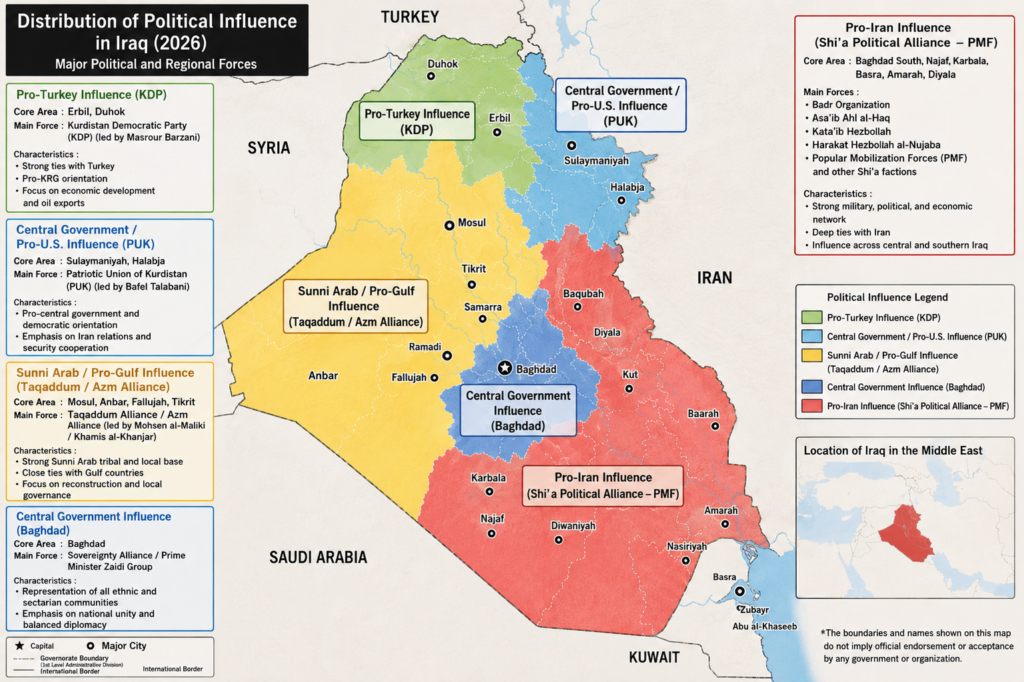
Figure 3
Source: Prepared by the Middle East and Asia Strategic Information Institute (MEASII) based on the CIA World Factbook (Iraq Maps), the UNOCHA Iraq Administrative Boundaries Map, United Nations Assistance Mission for Iraq (UNAMI) Reports, International Crisis Group Reports, Institute for the Study of War (ISW) Iraq Assessments, publications of the Independent High Electoral Commission of Iraq (IHEC), and official materials released by the Kurdistan Regional Government (KRG).
Note: This figure is a conceptual illustration compiled from publicly available information regarding administrative boundaries, major cities, political parties, armed organizations, and spheres of political influence. It should not be interpreted as an exact representation of territorial control or the prevailing security situation.
Additional Note: Rather than depicting formal administrative divisions, this map illustrates Iraq’s geopolitical spheres of influence during 2025–2026 based on political alignments, sectarian affiliations, and foreign policy orientations. Consequently, the boundaries shown do not necessarily coincide with official provincial borders.
Chapter 3 The Central Government and the Balanced Diplomacy Bloc
The Zaidi Administration and Its Multi-Directional Foreign Policy Strategy
3.1 The Position of the Central Government
The current Iraqi central government governs the country by maintaining a delicate balance among the Pro-Iran Bloc, the Kurdish political forces, and the Sunni political factions.
Since 2003, Iraqi politics has been characterized by coalition governments, making governance by any single political force virtually impossible. Consequently, the central government has assumed the dual responsibility of coordinating among Iraq’s principal domestic political actors while simultaneously maintaining stable diplomatic relations with neighboring states and major international partners.
Building upon the institutional framework inherited from the previous administration, the current government pursues a policy of balanced diplomacy that emphasizes constructive engagement with multiple regional and global powers.
3.2 Background to the Formation of the Government
In recent years, competition among Shi’a political factions has become one of the defining features of Iraqi politics.
Following the withdrawal of the Sadrist Movement from Parliament, the Coordination Framework—led primarily by pro-Iran political forces—assumed political leadership and established a new governing coalition.
As a result, the current central government is supported by:
- Pro-Iran political parties;
- the principal Kurdish political parties;
- the major Sunni political parties; and
- independent members of Parliament.
This broad coalition constitutes the political foundation of Iraq’s current governmental stability.
3.3 The Strategy of Balanced Diplomacy
The defining characteristic of the central government is its commitment to maintaining balanced relations with multiple regional and international partners.
(1) Relations with Iran
Iran is Iraq’s largest neighboring country and remains an indispensable partner in several strategic sectors, including:
- electricity supply,
- natural gas imports,
- religious exchanges, and
- security cooperation.
Accordingly, preserving stable relations with Iran continues to be a central component of Iraq’s national governance strategy.
(2) Relations with the United States
The United States continues to play an important role in training the Iraqi Armed Forces and supporting counterterrorism operations.
The bilateral partnership also encompasses:
- military assistance,
- intelligence sharing,
- financial support, and
- broader international cooperation.
As such, the United States remains one of Iraq’s principal strategic partners.
(3) Relations with the Gulf States
In recent years, investment from Saudi Arabia and the United Arab Emirates has expanded significantly.
The Iraqi central government has sought to strengthen economic cooperation with the Gulf states through initiatives including:
- regional electricity interconnection projects,
- infrastructure development,
- industrial expansion, and
- post-conflict reconstruction investment.
These projects have become increasingly important drivers of Iraq’s economic recovery and regional integration.
(4) Relations with China
China has substantially expanded its investment in Iraq as part of the Belt and Road Initiative.
China has become a major partner in several strategic sectors, particularly:
- oil and gas development,
- infrastructure construction,
- port development, and
- logistics and transportation networks.
Its growing economic presence has made China one of Iraq’s most significant long-term development partners.
3.4 The Geopolitical Role of the Central Government
Iraq occupies a strategic position at the intersection of the interests of the Middle East’s principal regional and global powers.
Consequently, the central government must maintain constructive relations simultaneously with:
- Iran,
- the United States,
- Türkiye,
- the Gulf Arab states, and
- China,
while maximizing Iraq’s national interests.
This strategy of balanced diplomacy enables Iraq to function as a regional balancer, reducing tensions among competing powers while preserving its own strategic autonomy.
3.5 Summary
Although the central government continues to rely, to some extent, on pro-Iran forces in the military and security domains, it pursues an increasingly independent course in foreign policy and economic affairs.
As a consequence, contemporary Iraq should not be viewed simply as a pro-Iran state. Rather, it has increasingly evolved into a state pursuing a strategy of balanced diplomacy, seeking pragmatic cooperation with multiple regional and global partners in order to safeguard its national interests and enhance its geopolitical flexibility.
Chapter 4 The Kurdish Sphere of Influence
The Dual Structure Dominated by the KDP and the PUK
4.1 Characteristics of the Kurdistan Region
The Kurdistan Region in northern Iraq enjoys the highest degree of autonomy within the Republic of Iraq.
However, the Kurdish political sphere is not governed by a single organization. Instead, it is dominated by two principal political parties:
- the Kurdistan Democratic Party (KDP); and
- the Patriotic Union of Kurdistan (PUK).
Although these parties cooperate in the administration of the Kurdistan Region, each maintains its own political base, regional sphere of influence, and distinct foreign policy orientation.
4.2 The Kurdistan Democratic Party (KDP)
Principal Areas of Influence
- Erbil
- Duhok Governorate
Political Leadership
The KDP is centered on the Barzani family and continues to serve as the dominant political force within the Kurdistan Regional Government (KRG).
Relations with Türkiye
The KDP places considerable emphasis on maintaining close economic relations with Türkiye.
This relationship is supported by several strategic factors, including:
- crude oil exports via Türkiye,
- cooperation on countering the Kurdistan Workers’ Party (PKK), and
- extensive economic ties with Turkish companies.
The Kurdistan Region’s oil exports rely heavily on pipeline infrastructure passing through Türkiye, making Türkiye the KDP’s most important economic partner.
In addition, Turkish companies have established a significant presence in Erbil, particularly in the construction, hospitality, retail, and energy sectors.
Geopolitical Significance
For Türkiye, northern Iraq represents a strategically important region for:
- containing PKK activities,
- ensuring energy security, and
- strengthening its southern defensive perimeter.
Conversely, for the KDP, Türkiye is an indispensable partner for oil exports, foreign investment, and access to international markets.
4.3 The Patriotic Union of Kurdistan (PUK)
Principal Areas of Influence
- Sulaymaniyah
- Halabja
- the border region adjoining Iran
Political Leadership
The PUK was founded by the late Jalal Talabani.
Today, the Talabani family continues to exercise substantial political influence within the party.
Relations with Iran
Due to its geographic proximity to the Iranian border, the PUK maintains close relations with Iran through:
- cross-border trade,
- people-to-people exchanges,
- security cooperation, and
- diplomatic engagement.
Consequently, the PUK-administered region often serves as one of Iran’s principal channels for maintaining political influence in northern Iraq.
Relations with the Central Government
Compared with the KDP, the PUK generally places greater emphasis on cooperation with the federal government in Baghdad.
In negotiations concerning the federal budget, the status of Kirkuk, and other national issues, the PUK has frequently adopted a more flexible and pragmatic approach than its political counterpart.
4.4 Comparison Between the KDP and the PUK
| Category | KDP | PUK |
|---|---|---|
| Principal Base | Erbil and Duhok | Sulaymaniyah |
| Leading Political Family | Barzani family | Talabani family |
| Relations with Türkiye | Close and cooperative | More cautious |
| Relations with Iran | Relatively distant | Comparatively close |
| Relations with Baghdad | Strong emphasis on regional autonomy | More cooperative |
| Relations with the PKK | Generally confrontational | Comparatively flexible |
4.5 Summary
The Kurdistan Region should not be regarded as a politically unified entity. Rather, it is best understood as a dual political structure dominated by the KDP and the PUK.
The KDP prioritizes economic integration and strategic cooperation with Türkiye, whereas the PUK places greater emphasis on maintaining stable relations with Iran and the federal government in Baghdad.
This dual political structure is of fundamental importance not only to the governance of northern Iraq but also to the broader geopolitical balance within Iraq as a whole.
Chapter 5 The Sunni and Gulf-Oriented Bloc
Expanding Cooperation with the Gulf States through Post-Conflict Reconstruction and Investment
5.1 Overview of the Sphere of Influence
The Sunni and Gulf-Oriented Bloc has expanded its political influence in the post-ISIS era, driven largely by the extensive reconstruction efforts undertaken following the defeat of the Islamic State.
Its principal areas of activity include:
- Mosul
- Al Anbar Governorate
- Fallujah
- Ramadi
- Tikrit
Because these regions suffered extensive destruction during the conflict with ISIS, post-war reconstruction, infrastructure rehabilitation, and job creation have become their highest policy priorities.
5.2 The Taqaddum Alliance
The Taqaddum Alliance is currently the largest Sunni political bloc in Iraq.
It is led by Mohammed al-Halbousi, whose principal political support is concentrated in Al Anbar Governorate.
The alliance is characterized by:
- a strong emphasis on effective local governance,
- active promotion of post-conflict reconstruction policies,
- efforts to attract investment from the Gulf states, and
- close political and economic relations with Saudi Arabia and other Gulf Arab states.
As a former Speaker of the Iraqi Parliament, Mohammed al-Halbousi remains one of the most prominent and influential figures in contemporary Sunni politics.
5.3 The Azm Alliance
The Azm Alliance is another major Sunni political coalition led by Khamis al-Khanjar.
Its principal areas of activity are concentrated around Mosul and other Sunni-majority areas in northern Iraq.
The alliance emphasizes:
- the restoration of Sunni political representation,
- regional reconstruction and development,
- economic cooperation with the Gulf states, and
- balancing against excessive Iranian influence.
In particular, the Azm Alliance has actively promoted economic cooperation with Saudi Arabia, the United Arab Emirates, and Jordan in order to attract reconstruction investment and stimulate regional economic growth.
5.4 Comparison of the Taqaddum and Azm Alliances
| Category | Taqaddum Alliance | Azm Alliance |
|---|---|---|
| Principal Leader | Mohammed al-Halbousi | Khamis al-Khanjar |
| Primary Political Base | Al Anbar Governorate | Mosul and surrounding areas |
| Political Character | Administrative and local governance-oriented | Business and tribal coalition |
| Relations with the Gulf States | Strong | Strong |
| Position toward Iran | Maintains political distance | Maintains political distance |
5.5 Geopolitical Significance
The Sunni-majority regions have become the principal destinations for economic investment from the Gulf Arab states.
In particular, Iraq has strengthened its economic and political cooperation with:
- Saudi Arabia,
- the United Arab Emirates, and
- Jordan.
These relationships have transformed the Sunni political sphere into an important gateway for improving Iraq’s broader relations with the Arab world.
Accordingly, the Sunni political forces have expanded their influence not through military power but through economic reconstruction, investment promotion, and regional development initiatives.
5.6 Summary
The Sunni and Gulf-Oriented Bloc has steadily increased its political significance in the post-ISIS period, benefiting from the growing demand for reconstruction and economic recovery.
As cooperation with the Gulf Arab states continues to deepen, this political bloc is expected to play an increasingly important role in Iraq’s long-term economic reconstruction, regional integration, and overall political stability.
Chapter 6 Regional Distribution of Political Forces
6.1 Distribution of Political Influence by Region
The current distribution of political influence across Iraq can be broadly summarized as follows.
| Region | Predominant Political Bloc | Principal Actors |
|---|---|---|
| Baghdad | Central Government and Balanced Diplomacy Bloc | Federal Government |
| Najaf | Pro-Iran Bloc | Shi’a Religious Establishment |
| Karbala | Pro-Iran Bloc | Shi’a Religious Establishment |
| Basra | Pro-Iran Bloc | Badr Organization and Popular Mobilization Forces |
| Amarah | Pro-Iran Bloc | Asa’ib Ahl al-Haq |
| Al Anbar Governorate | Sunni and Gulf-Oriented Bloc | Sunni Tribal Forces |
| Mosul | Sunni and Gulf-Oriented Bloc | Taqaddum Alliance and Azm Alliance |
| Erbil | Kurdistan Democratic Party | Kurdistan Regional Government |
| Sulaymaniyah | Patriotic Union of Kurdistan | Kurdistan Regional Government |
6.2 Characteristics of the Regional Power Structure
The distribution of political power within Iraq varies significantly from one region to another.
In southern Iraq, the Pro-Iran Bloc remains politically dominant, drawing its influence from the country’s major oil-producing regions and the authority of the Shi’a religious establishment.
In the Kurdistan Region of northern Iraq, the autonomous government is jointly administered by the Kurdistan Democratic Party and the Patriotic Union of Kurdistan, each pursuing distinct regional interests and foreign policy orientations.
Meanwhile, in the Sunni-majority provinces of western Iraq, relations with the Gulf Arab states have deepened through large-scale reconstruction investment, infrastructure development, and expanding economic cooperation.
These differing regional dynamics illustrate that Iraq’s political landscape is characterized not by a single center of power, but by a geographically diverse and multidimensional distribution of political influence.
Chapter 7 Iraqi Politics as a Four-Pole Structure
7.1 The Current Balance of Political Forces
As of 2026, Iraq’s political system is characterized by a dynamic equilibrium in which four principal political blocs interact while maintaining a balance of power.
The Pro-Iran Bloc
- Maintains predominance in the military and security sectors;
- Holds substantial parliamentary influence; and
- Exercises strong control over the Shi’a-majority provinces of southern Iraq.
The Central Government
- Oversees the administration of the Iraqi state;
- Pursues a strategy of balanced, multi-directional diplomacy; and
- Serves as the principal coordinator among Iraq’s competing political forces.
The Kurdish Bloc
- Governs the autonomous Kurdistan Region in northern Iraq;
- Controls significant energy resources; and
- Maintains strategic relations with both the United States and Türkiye.
The Sunni and Gulf-Oriented Bloc
- Functions as the principal recipient of post-conflict reconstruction investment;
- Continues to strengthen economic cooperation with the Gulf Arab states; and
- Plays a leading role in regional reconstruction and economic development.
7.2 Assessment of Relative Influence
The current distribution of political influence can be summarized as follows.
| Sector | Predominant Actor |
|---|---|
| Military and Security | Pro-Iran Bloc |
| Parliamentary Politics | Pro-Iran Bloc |
| Investment and Economic Development | Gulf Arab States and the Sunni Political Bloc |
| Northern Border Region | Türkiye and the Kurdistan Democratic Party |
| Foreign Affairs | Central Government |
7.3 Geopolitical Assessment
Contemporary Iraq possesses several defining geopolitical characteristics:
- A strategic buffer state between Iran and the Gulf Arab states;
- A critical hub within China’s Belt and Road Initiative;
- An essential component of Türkiye’s southern security architecture; and
- A region in which the United States continues to maintain significant strategic influence through its military presence.
Accordingly, Iraq remains one of the Middle East’s principal strategic crossroads, where the interests of multiple regional and global powers converge.
Conclusion
As of 2026, the Pro-Iran Bloc continues to maintain a dominant position within Iraq’s Parliament and security institutions.
At the same time, however, expanding investment from Saudi Arabia, the United Arab Emirates, and Türkiye has significantly strengthened Iraq’s economic ties with regional partners. Consequently, Iraq can no longer be accurately characterized simply as a pro-Iran state.
Meanwhile, the Iraqi central government continues to pursue a strategy of balanced diplomacy by maintaining constructive relations with the United States, China, Iran, and the Gulf Arab states, thereby serving as a regional balancer among competing powers.
Looking ahead, Iraq’s future political and security environment is likely to be shaped primarily by five key factors:
- The preservation of Iranian influence;
- The future status of Kurdish autonomy;
- Türkiye’s cross-border military operations;
- Expanding investment by the Gulf Arab states; and
- The future of the United States military presence in Iraq.
Accordingly, the most accurate framework for understanding contemporary Iraq is to view it as a four-pole state in which the Pro-Iran Bloc retains political and military predominance, while Türkiye, the Gulf Arab states, and the United States compete for economic influence and broader regional leverage.
References
- United Nations Assistance Mission for Iraq (UNAMI), Reports
- United Nations Office for the Coordination of Humanitarian Affairs (UNOCHA)
- International Crisis Group, Reports
- Institute for the Study of War (ISW), Iraq Assessments
- Publications of the Independent High Electoral Commission of Iraq (IHEC)
- Publications of the Kurdistan Regional Government (KRG)
- Publications of the Iraq Ministry of Oil
- World Bank, Iraq Economic Reports
- International Energy Agency (IEA), Reports
- Various publicly available statistical datasets and official government publications
Sources of Figures
Figure 1: Distribution of Major Political and Geopolitical Forces in Iraq (2026)
Figure 2: Five Strategic Challenges Facing Iraq and the Geopolitical Structure of the Middle East
Sources:
- CIA World Factbook (Iraq Maps)
- UNOCHA Iraq Administrative Boundaries Map
- UNAMI Reports
- International Crisis Group Reports
- Institute for the Study of War (ISW) Iraq Assessments
- Publications of the Independent High Electoral Commission of Iraq (IHEC)
- Publications of the Kurdistan Regional Government (KRG)
Compiled and prepared by the Middle East and Asia Strategic Information Institute (MEASII).
Note: The figures are conceptual illustrations prepared from publicly available information concerning administrative boundaries, major cities, political parties, armed organizations, and spheres of political influence. They are intended for analytical purposes only and should not be interpreted as depicting actual territorial control or the prevailing security situation.
Furthermore, the maps illustrate the geopolitical spheres of influence in Iraq during the 2025–2026 period, based on political alignments, sectarian affiliations, and foreign policy orientations. Accordingly, the boundaries shown do not necessarily correspond to official administrative divisions.
Colophon
Title:
Political Power Map of Iraq 2026
— Iraq as a Four-Pole State and the Geopolitical Reconfiguration of the Middle East —
Fields of Study:
- Middle East Security
- International Politics
- Geopolitics
- Energy Security
Published by:
Middle East and Asia Strategic Information Institute
© Middle East and Asia Strategic Information Institute. All Rights Reserved.
・Author: Akinobu Kinoshita
An independent analyst specializing in political affairs, security, and information strategy across the Middle East and Asia. Drawing on over 30 years of field networks and hands-on experience at the government level, he founded the Middle East Asia Information Strategy Institute in 2025. Author of ISIS to Tatakau (Aiikusha, 2016).